
Dauphin County Court Records and Criminal Case Lookup
Dauphin County felony records are held by the Clerk of Courts at the Dauphin County Courthouse in Harrisburg, Pennsylvania. Harrisburg serves as both the county seat and the state capital, which means many Pennsylvania criminal justice agencies are located right here. You can search case dockets online through the statewide UJS portal or visit the courthouse at 101 Market Street. This guide explains how the local court system works, what records are available, and how state resources connect to Dauphin County cases.
Dauphin County Quick Facts
Dauphin County Court of Common Pleas
The Dauphin County Court of Common Pleas is located at the Dauphin County Courthouse, 101 Market Street, Harrisburg, PA 17101. All felony criminal cases filed in Dauphin County are handled by this court. Because Harrisburg is the state capital, the courthouse sits near a concentration of state government offices, making it one of the more active courthouses in Pennsylvania.
Two distinct offices manage different types of court records. The Clerk of Courts is Tina L. Nixon, whose office is in Room 103 at the courthouse. This office handles all criminal filings, docket sheets, and court orders for felony cases. The Prothonotary is Antonio Carreno, whose office handles civil filings from the same courthouse. Both offices can be reached at (717) 255-6323. For felony records, Tina L. Nixon's office is the correct point of contact.
Dauphin County was incorporated on March 4, 1785, also carved out of Lancaster County. Court records here go back to that founding year. Land records and probate records trace to 1785. Birth and death records exist for two separate periods: 1852 to 1854 and 1893 to 1906. Marriage records cover 1852 to 1855. These historical records are stored at the courthouse and some have been microfilmed or digitized over the years.
| Office | Clerk of Courts |
|---|---|
| Officer | Tina L. Nixon |
| Address | 101 Market Street, Room 103, Harrisburg, PA 17101 |
| Phone | (717) 255-6323 |
| Website | www.dauphincounty.org |
| State Capital | Yes |
| PA Courts Page | pacourts.us |
The image below is sourced from the Dauphin County official website, showing the sheriff's office presence in Harrisburg.

The county website provides links to court offices, meeting schedules, and public access resources for residents.
Note: The Prothonotary and Clerk of Courts are separate elected offices in Dauphin County and handle different categories of court records.
Searching Dauphin County Felony Records
The primary online resource for Dauphin County felony records is the Pennsylvania Unified Judicial System portal. This free statewide tool allows searches by name, date of birth, or docket number. Results show criminal docket sheets for cases filed in the Court of Common Pleas, including the grade of each charge, the case status, and dates of significant court actions.
The UJS portal draws from case data maintained by the Administrative Office of Pennsylvania Courts. Dauphin County felony cases going back many years are accessible through this system. Updates typically reflect recent court actions within a few business days, though real-time synchronization is not guaranteed. For the most current status of an active case, calling the Clerk of Courts office directly is the most reliable approach.
In-person searches at the courthouse provide access to physical case files and exhibits. Older records that predate digital indexing may only be available on site. The county's own site at dauphincounty.org lists office hours, parking information, and links to court-related departments. Written mail requests are also accepted by the Clerk of Courts, though processing times vary depending on volume.
Note: Online records through the UJS portal are available at no cost and do not require a login or account.
Dauphin County Criminal Court Dockets
The Clerk of Courts in Dauphin County maintains the official record of every criminal case processed through the Court of Common Pleas. For felony cases, the docket sheet is the core document. It lists every step taken by the court from the initial filing through final disposition, including any appeals or post-conviction motions.
A felony case docket in Dauphin County typically contains the defendant's name and date of birth, each charge and its offense grade, the plea entered, all scheduled and completed hearing dates, the assigned judge, the verdict, and the sentence imposed. If a case involved multiple defendants or was consolidated with other matters, the docket reflects those connections as well.
The Clerk also tracks bench warrants and capias orders tied to criminal cases. If someone failed to appear at a required court date, that action is logged and becomes part of the permanent case history. These entries stay on the docket even if the warrant was later recalled or the person appeared voluntarily.
Charging documents, criminal informations, and affidavits of probable cause are filed with the Clerk and may be accessed as part of the case file. Some documents within a case file may be restricted by court order, but the docket itself is generally a public record under Pennsylvania court rules and accessible to anyone who requests it.
The image below is sourced from the Pennsylvania Courts website, which lists Dauphin County court information and judicial contacts.
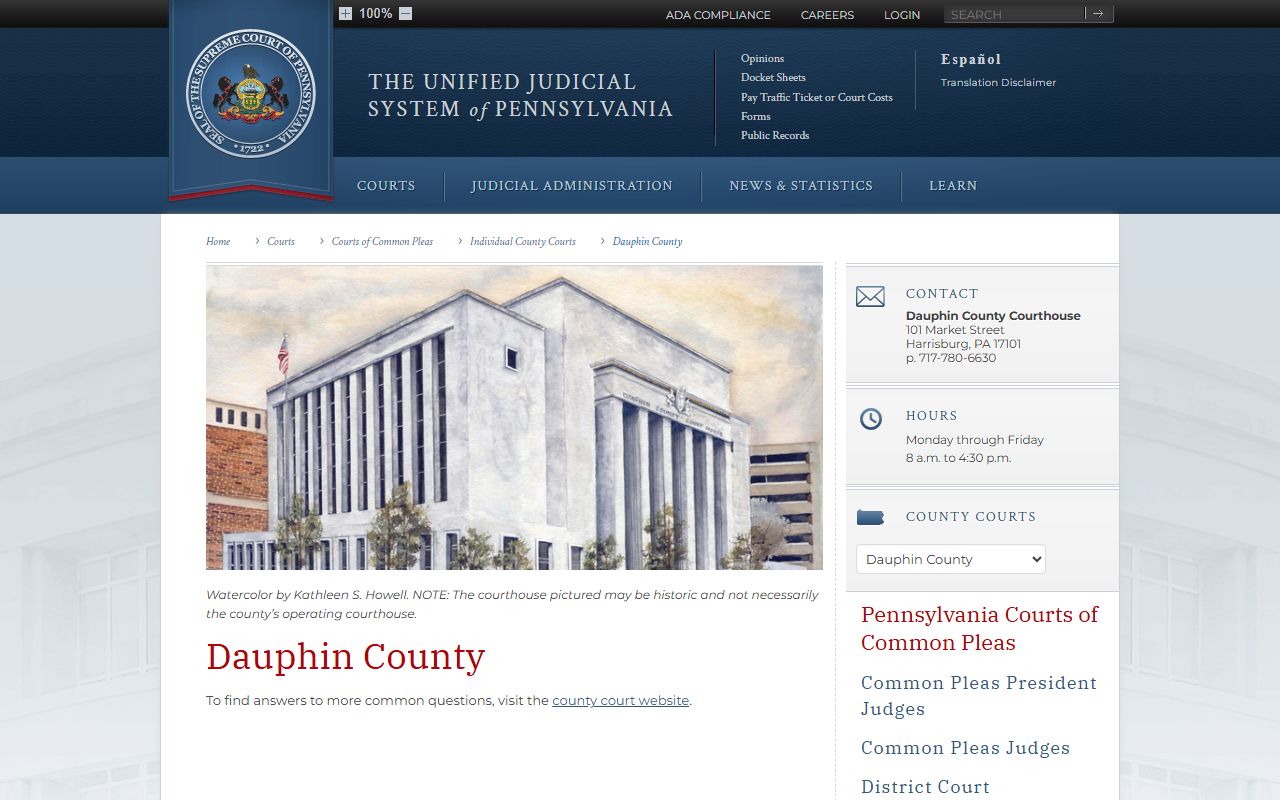
The PA Courts site is an authoritative source for judge assignments, court schedules, and courthouse contact details across all 67 Pennsylvania counties.
Pennsylvania PATCH System in Dauphin County
The Pennsylvania State Police headquarters is located at 1800 Elmerton Avenue in Harrisburg, placing it within Dauphin County itself. PSP operates the PATCH system, which stands for Pennsylvania Access To Criminal History. PATCH is the state's official background check tool and draws from the criminal history repository maintained under 18 Pa.C.S. § 9101, which defines the framework for criminal history record information in Pennsylvania.
PATCH results summarize convictions and final dispositions reported to the state repository by courts and law enforcement agencies across Pennsylvania. A PATCH report does not capture every docket entry the way the UJS portal does. It reflects what has been formally transmitted to the PSP repository. Dismissed charges and non-conviction outcomes may appear differently on PATCH than they do on a full court docket.
Individuals can request their own PATCH record through the Pennsylvania State Police website. The self-request process is straightforward and returns results that reflect the individual's statewide criminal history. Third-party access is subject to authorization requirements under the Criminal History Record Information Act, referenced in 18 Pa.C.S. § 9121.
Because PSP headquarters is physically located in Harrisburg, Dauphin County residents have a unique proximity to the agency that administers the state background check system. However, the PATCH submission process is entirely online and functions the same way for anyone in Pennsylvania.
Note: For Dauphin County cases specifically, combining a PATCH check with a UJS docket search gives the most complete picture of a person's criminal history.
Clean Slate and Expungement in Dauphin County
Pennsylvania's Clean Slate 3.0, enacted on February 12, 2024, extended automatic sealing to cover certain felony convictions after a ten-year period with no new offenses. When a case qualifies, the sealing happens without the individual needing to file anything. The court system processes these automatically based on the criteria set in the law.
Felonies involving violence, weapons, or sexual offenses are excluded from automatic sealing. For those offenses, the individual must file a petition with the Clerk of Courts in Dauphin County. The Clerk's office at Room 103, 101 Market Street accepts these petitions. The District Attorney's office reviews petitions, and a judge holds a hearing before any order is entered.
The Pennsylvania Board of Pardons is located in Harrisburg, again within Dauphin County. The Board reviews clemency applications for all Pennsylvania convictions. A governor-signed pardon opens the door to a subsequent expungement petition filed with the sentencing court. Dauphin County residents apply through the same statewide Board of Pardons process used by residents of every other county.
For non-conviction cases, 18 Pa.C.S. § 9122 allows courts to grant expungements where charges were dismissed, where the defendant was found not guilty, or where an Accelerated Rehabilitative Disposition program was completed. These petitions do not require a ten-year wait and are handled through the Clerk of Courts office in the same building.
Note: Sealed records under Clean Slate remain accessible to law enforcement agencies and certain state licensing boards even after they are removed from public view.
Open Records Access in Dauphin County
Pennsylvania's Right-to-Know Law at 65 P.S. § 67.101 establishes the public's right to access government records. Criminal court dockets in Dauphin County are presumed public under Pennsylvania court rules and do not typically require a formal RTKL request to access. The UJS portal and the Clerk of Courts office are the standard channels for court record access.
The RTKL process is most relevant for non-court government records, such as incident reports held by the Harrisburg Bureau of Police or documents maintained by county agencies. The county website at dauphincounty.org provides a formal RTKL submission process for county-held records. Requesters can submit written requests to the county's designated Open Records Officer.
The Pennsylvania Office of Open Records handles appeals statewide when agencies deny record requests. If a denial is received, the requester has 15 business days to file an appeal. The OOR provides appeal forms and guidance on its website. Decisions from the OOR are binding on agencies unless challenged in court.
Some categories of records are restricted by statute even if they relate to criminal matters. Juvenile court records, records sealed under Clean Slate 3.0, victim contact information, and certain mental health-related filings are not open to general public access. When a request covers both open and restricted material, the agency may provide the open portions while redacting the restricted content.
Note: Court records held by the Clerk of Courts fall under the supervision of the court system, not the county RTKL officer, so requests for dockets are best directed to the Clerk directly.
Cities in Dauphin County
Dauphin County is anchored by Harrisburg, the state capital and by far the largest city in the county. Other communities include Steelton, Middletown, Hummelstown, Millersburg, and Highspire. The county also includes Hershey, home of Penn State Health Milton S. Hershey Medical Center and a number of state-connected institutions. The diversity of communities in the county reflects a broad range of economic activity from government and healthcare to manufacturing and agriculture.
Nearby Counties
Dauphin County shares borders with several Pennsylvania counties, each maintaining its own Clerk of Courts and criminal case records through the statewide UJS system.