
Find Pennsylvania Felony Records Online
Pennsylvania Felony Records are public documents created when a person is charged with or convicted of a felony offense in the state court system. These records are maintained across multiple state and county agencies, including the Pennsylvania State Police, the Unified Judicial System, and the Department of Corrections. This guide covers where to search, what tools are available, and how the court structure works so you can locate accurate felony record information across all 67 Pennsylvania counties.
Pennsylvania Felony Records Quick Facts
Pennsylvania Felony Records Overview
A felony in Pennsylvania is a serious criminal offense that can result in a state prison sentence. Felonies are broken into three degrees. First-degree felonies carry up to 20 years in prison. Second-degree felonies carry up to 10 years. Third-degree felonies carry up to 7 years. Crimes such as robbery, rape, aggravated assault, homicide, and many drug trafficking offenses fall into these categories.
Felony records in Pennsylvania originate from several sources. The arresting law enforcement agency creates an initial report. The district court or Magisterial District Judge (MDJ) processes the preliminary hearing. The Court of Common Pleas in each county handles the trial, sentencing, and all related court documents. After sentencing, the Pennsylvania Department of Corrections (DOC) maintains custody records. The Pennsylvania State Police Central Repository holds the official criminal history for each person. Under 18 Pa.C.S. § 9101, this system is governed by the Criminal History Record Information Act (CHRIA), which defines how criminal records are created, stored, and shared. Each agency plays a distinct role, and a complete picture of someone's felony record may require checking more than one source.
Pennsylvania's open records framework, shaped by 65 P.S. § 67.101 under the Right-to-Know Law, supports public access to many of these documents. Court filings are generally accessible to the public unless a judge has ordered them sealed.
Pennsylvania State Police PATCH Background Checks
The official source for Pennsylvania criminal history records is the PATCH system, which stands for Pennsylvania Access to Criminal History. It is managed by the Pennsylvania State Police and draws from the Central Repository. PATCH provides the most complete and accurate criminal history data available to the public. It is the only service that can generate an official background check report certified by the state.
The official PA State Police homepage is shown here, which serves as the entry point for the PATCH system and related criminal history services. The state police maintain the Central Repository under the authority granted by 18 Pa.C.S. § 9101.
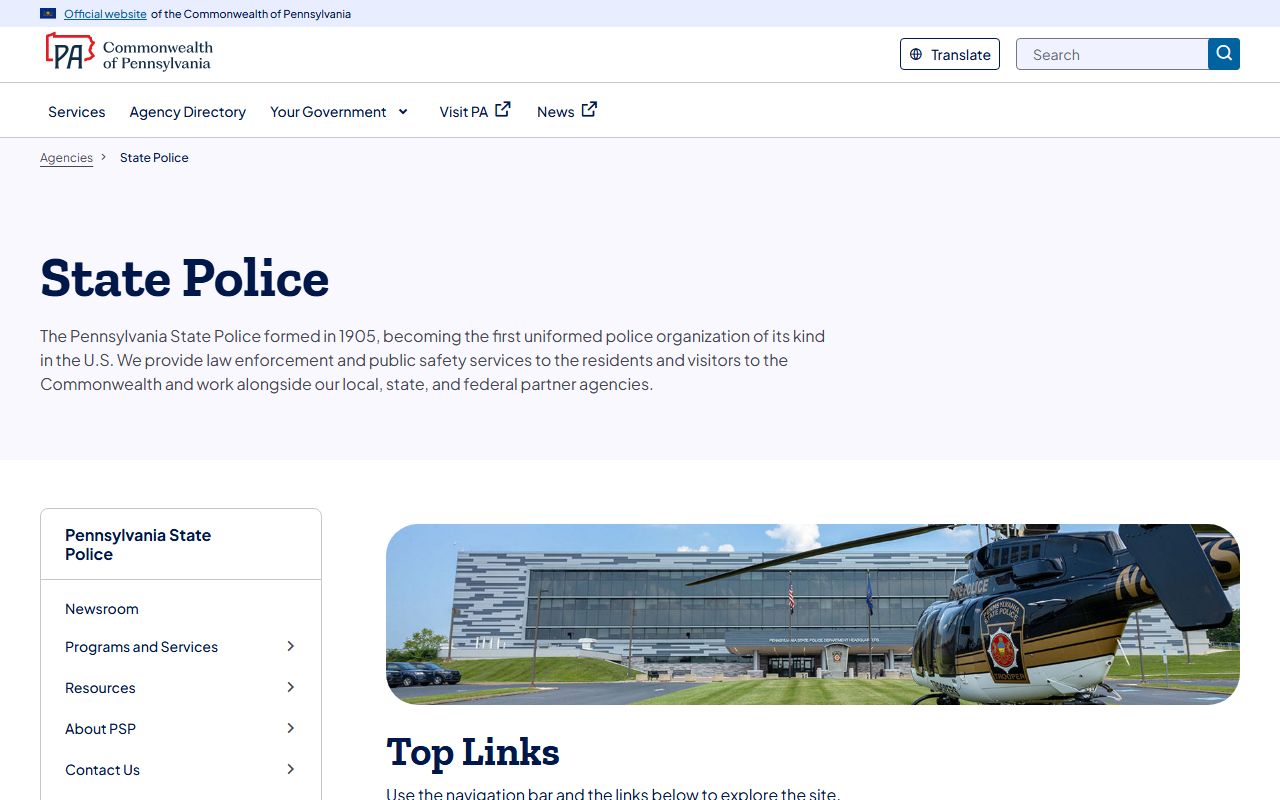
The PATCH portal gives you quick online access to criminal history checks for a small fee, and results are delivered instantly in most cases.
You can also request a criminal history check by mail. Send a completed Form SP4-170 along with a $20 money order payable to the Commonwealth of Pennsylvania. Mail it to PA State Police Central Repository-164, 1800 Elmerton Avenue, Harrisburg, PA 17110-9758. The mail-in process takes longer than the online option. For questions, call the PATCH helpline at 1-888-QUERY-PA (1-888-783-7972).
Note: The UJS Portal provides case-level information but is not a substitute for an official PATCH criminal history check, which is the only report certified by the Pennsylvania State Police.
UJS Portal: Pennsylvania Felony Records Court Search
The Unified Judicial System (UJS) of Pennsylvania operates a free public portal where anyone can search court cases by name, date of birth, docket number, OTN (Offense Tracking Number), state ID, case status, date filed range, or police incident number. The portal covers both Magisterial District Judge courts and Courts of Common Pleas across all 67 counties. It is one of the most used tools for locating Pennsylvania felony records without paying a fee.
The main UJS Portal landing page, shown here, is the starting point for all public court record searches in Pennsylvania. This portal links to several search tools and also provides access to docket sheets for criminal, civil, and appellate cases.
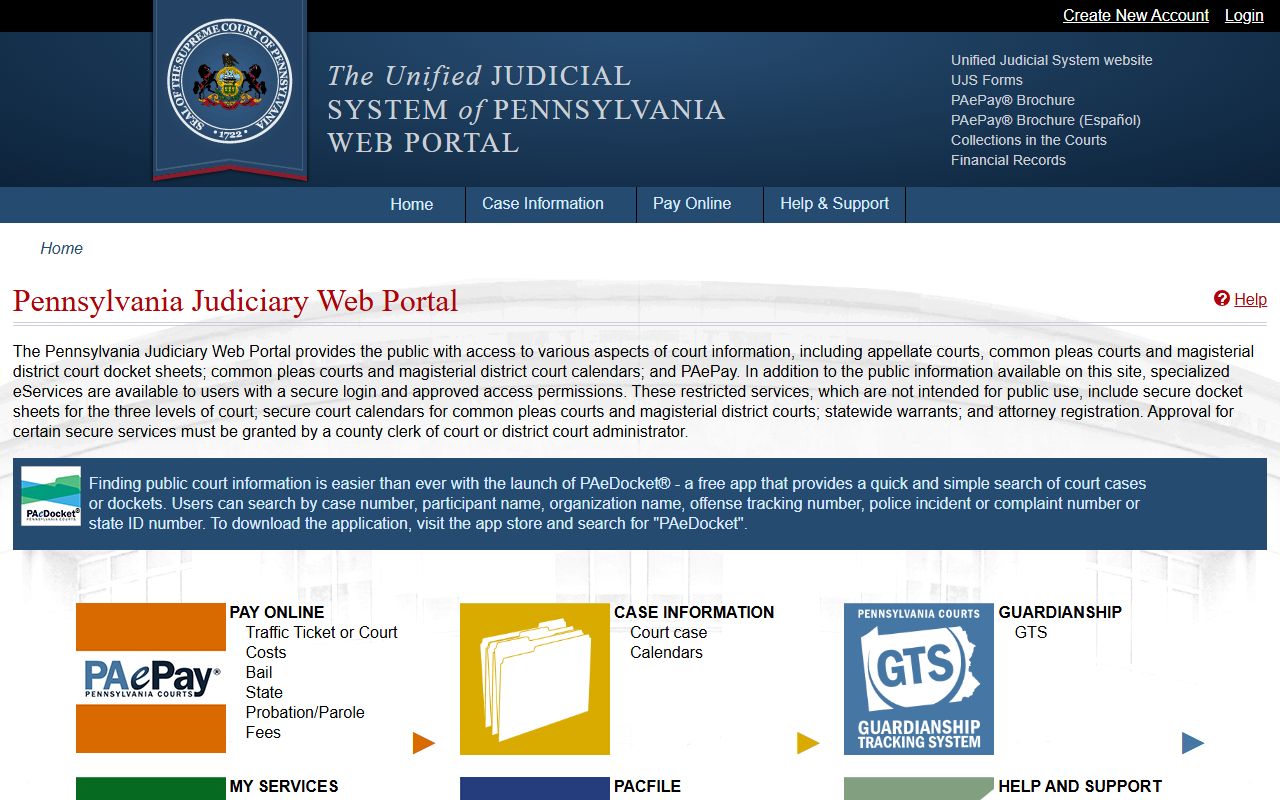
From the portal homepage you can reach the full case search tool in just one click.
Docket number format matters when you search. Cases in Magisterial District Judge courts begin with the prefix "MJ." Cases in the Courts of Common Pleas use the prefix "CP." Knowing the correct prefix saves time when you already have a case number in hand. The UJS Case Search interface lets you filter by court type so you can narrow results quickly.
The UJS Case Search page itself, pictured here, displays the full set of search fields available to the public for locating felony and other criminal case records across Pennsylvania courts.
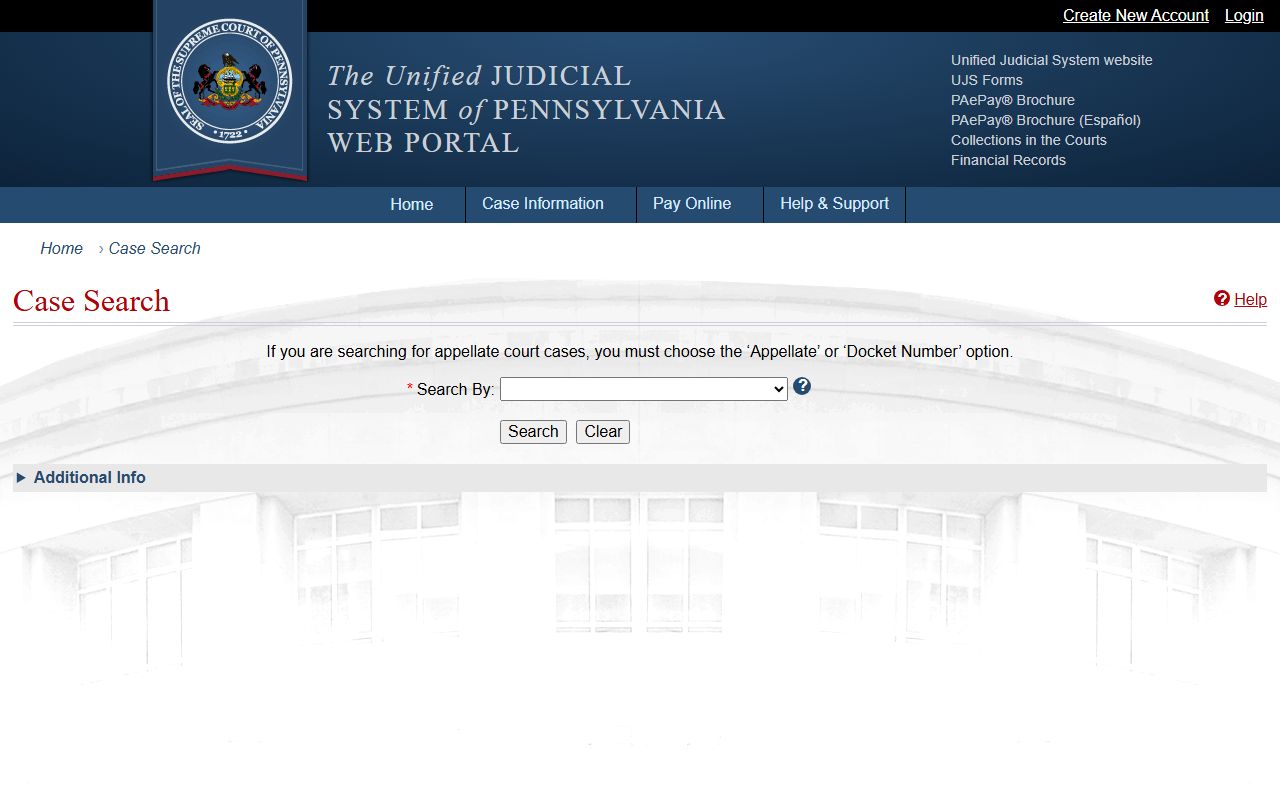
Search results link directly to full docket sheets, which include charges, dispositions, sentencing information, and attorney listings for each case.
The Pennsylvania Courts also offer the Court Case Information public page, which outlines what information is available and what the Electronic Case Records Public Access Policy excludes. That policy removes Social Security numbers, operator license numbers, victim information, juror information, financial account numbers, and SID numbers from public-facing records. Those exclusions protect privacy while still keeping the core case details open. There is also a free mobile app called PAeDocket that lets you search court cases quickly from a phone or tablet.
The public court case information page, shown here, explains the scope of what records are available through the UJS system and how the public access policy governs them.
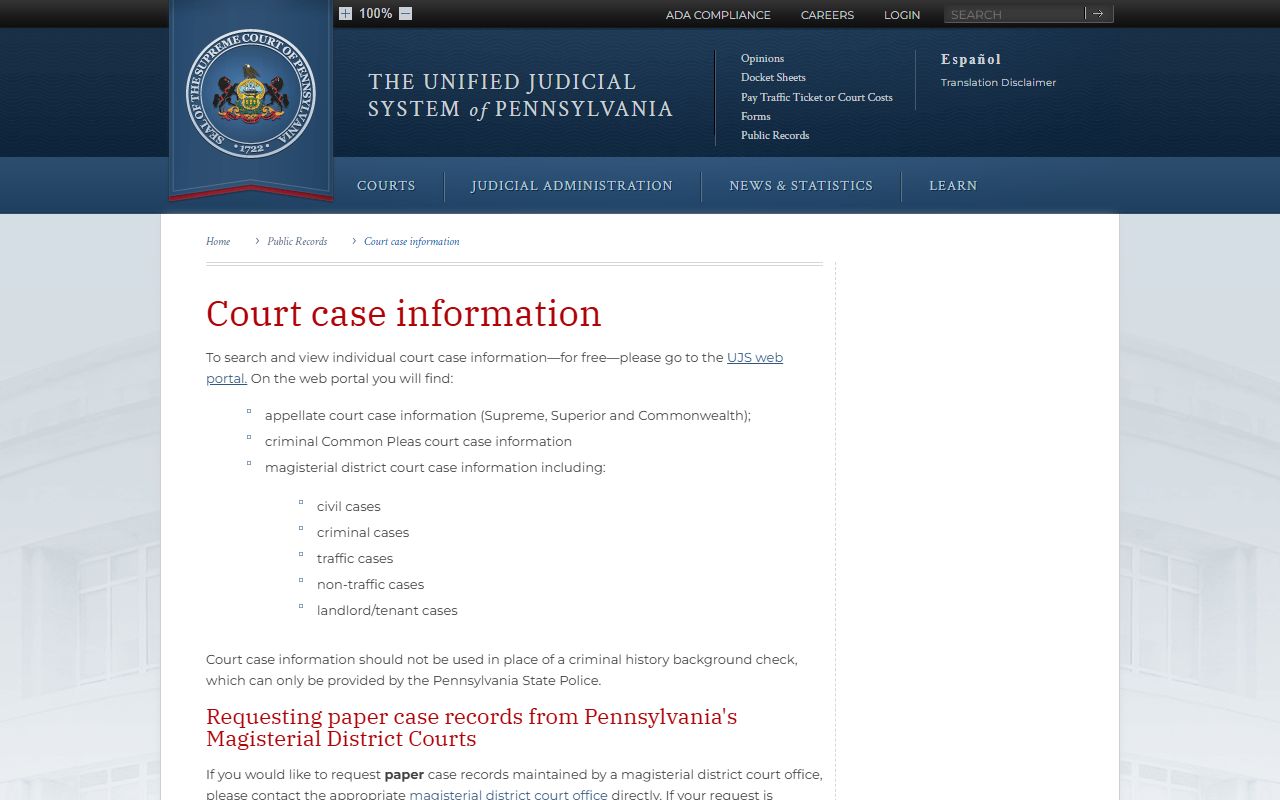
This page is a useful reference before you start a search so you know exactly what to expect from the results.
How to Search Pennsylvania Felony Records Online
Start at the UJS Case Search page. You do not need to create an account or pay a fee. Enter the person's last name and first name in the name fields. Adding a date of birth will narrow results significantly when the name is common. The system will return a list of matching cases with court location, docket number, case status, and filing date.
Once you find the correct case, click the docket number to open the full docket sheet. The sheet shows each charge with the relevant statute, the disposition (guilty, not guilty, nolle prosequi, etc.), the sentence imposed, and any supervision status. You can print or save the docket sheet as a PDF directly from the portal. This is free and available 24 hours a day. If you need a certified copy, you must contact the Prothonotary or Clerk of Courts in the county where the case was filed.
Note: Name searches on the UJS Portal may return multiple people with the same name, so always verify the date of birth and county before drawing conclusions from a docket sheet.
Pennsylvania DOC Inmate Felony Records Search
The Pennsylvania Department of Corrections (DOC) operates 24 state correctional institutions and houses more than 36,000 people on any given day. If you are looking for a person currently incarcerated or recently released from a state prison, the DOC Inmate Locator is the right tool. It is separate from the UJS Portal and pulls data directly from DOC custody records.
The DOC Inmate Locator page, shown here, is the official gateway for searching incarcerated individuals within the Pennsylvania state prison system.
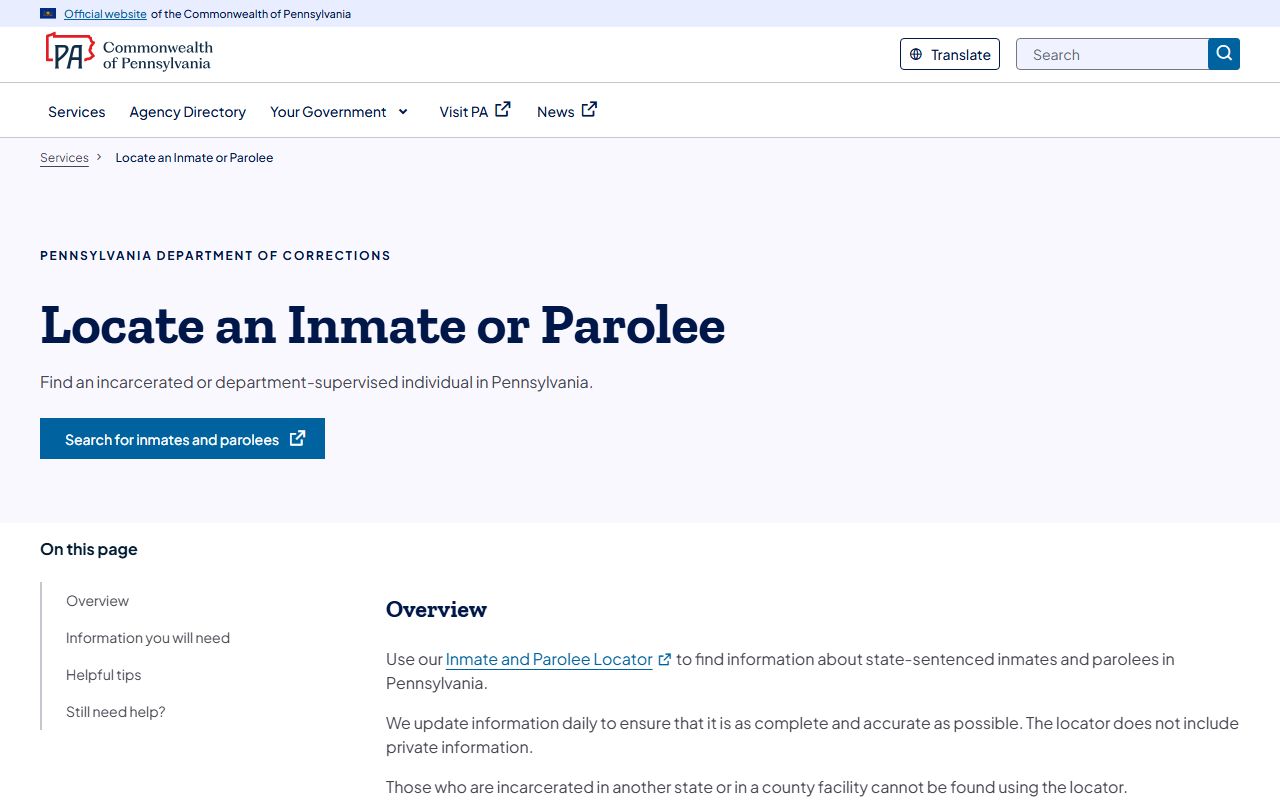
The locator supports searches by multiple fields, making it easier to find the right person even with limited information.
The search tool accepts name, inmate number, committing county, facility location, gender, race, and date of birth. You can use just one field or combine several to narrow results. The Direct Inmate Locator offers a slightly different interface that some users find faster for simple name searches.
The direct inmate locator search tool, pictured here, provides a streamlined way to look up Pennsylvania state prison inmates by name or inmate number.
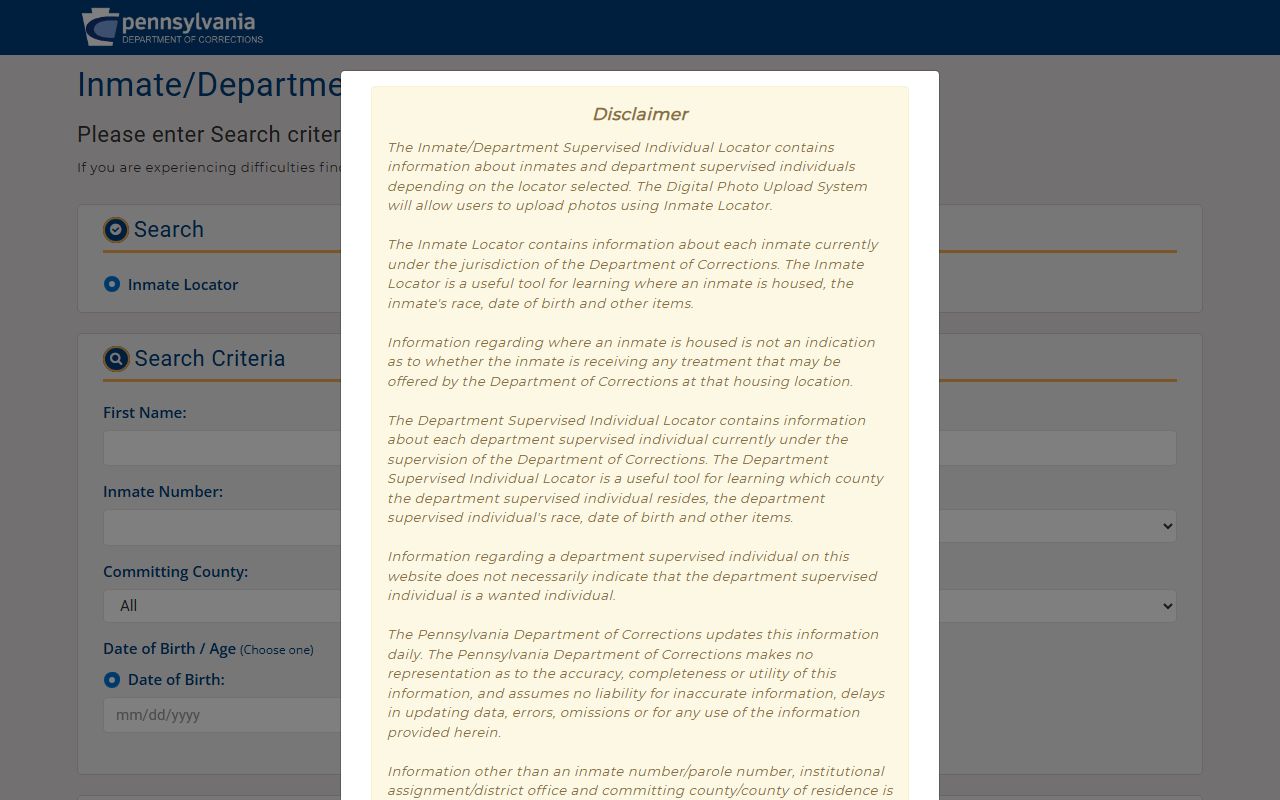
Results include the person's current facility, commitment date, and projected release date where applicable.
Pennsylvania Court Structure for Felony Cases
Understanding how Pennsylvania courts are organized helps when you are searching for felony records. Most felony cases begin at the Magisterial District Judge (MDJ) level with a preliminary arraignment and preliminary hearing. The case then moves to the Court of Common Pleas in the relevant county, which is where trials, pleas, and sentences happen. Pennsylvania has 67 Courts of Common Pleas, one for each county. Some rural counties share a judicial district with a neighboring county.
The Courts of Common Pleas page, shown here, provides a directory of all 67 county-level courts where felony trials and sentencing take place in Pennsylvania.
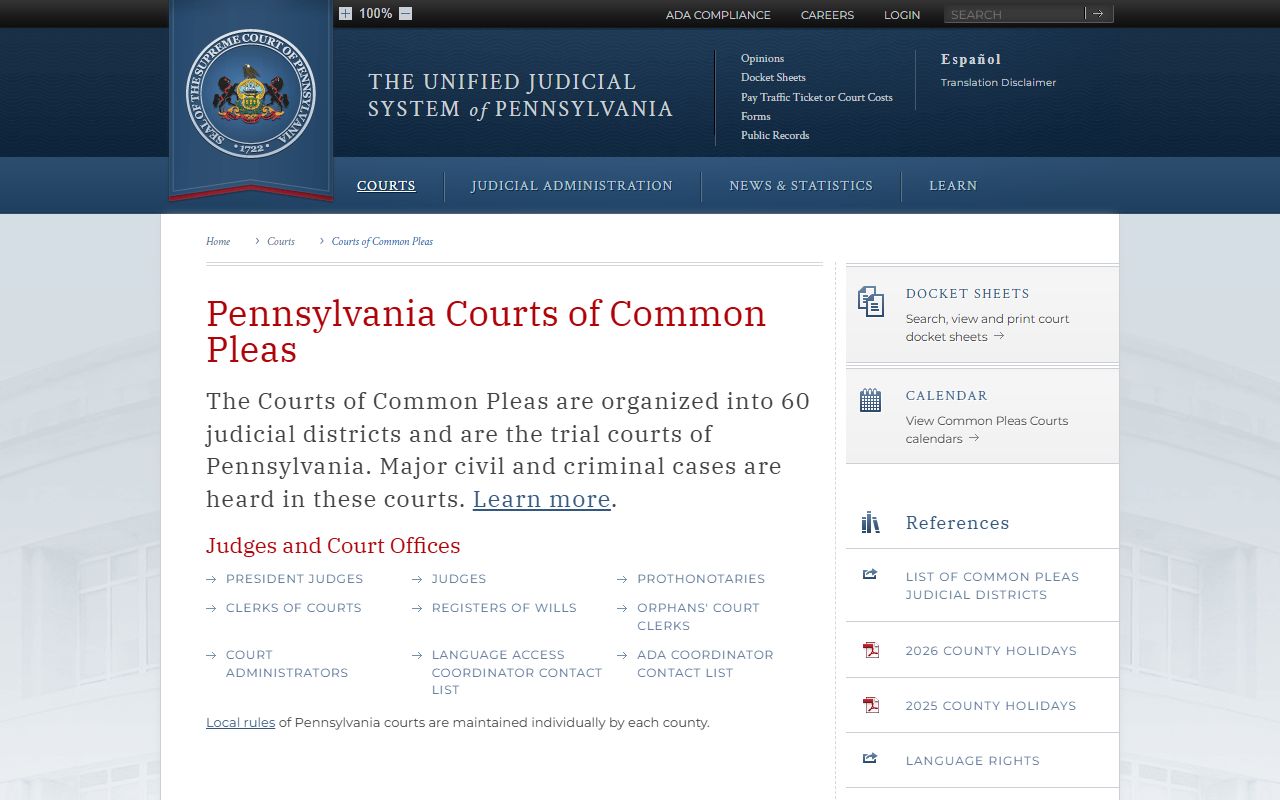
Each Court of Common Pleas maintains its own clerk of courts office, which holds the physical files for all criminal cases in that county.
Above the Courts of Common Pleas sit two intermediate appellate courts. The Superior Court handles direct appeals in criminal cases. The Commonwealth Court handles appeals involving government agencies. Above both of those is the Pennsylvania Supreme Court, which is the court of last resort. Decisions from the Supreme Court on felony cases set binding precedent for all lower courts in the state.
The PA Supreme Court homepage, shown here, covers the court's role in criminal appeals and its authority over felony record law across the state.
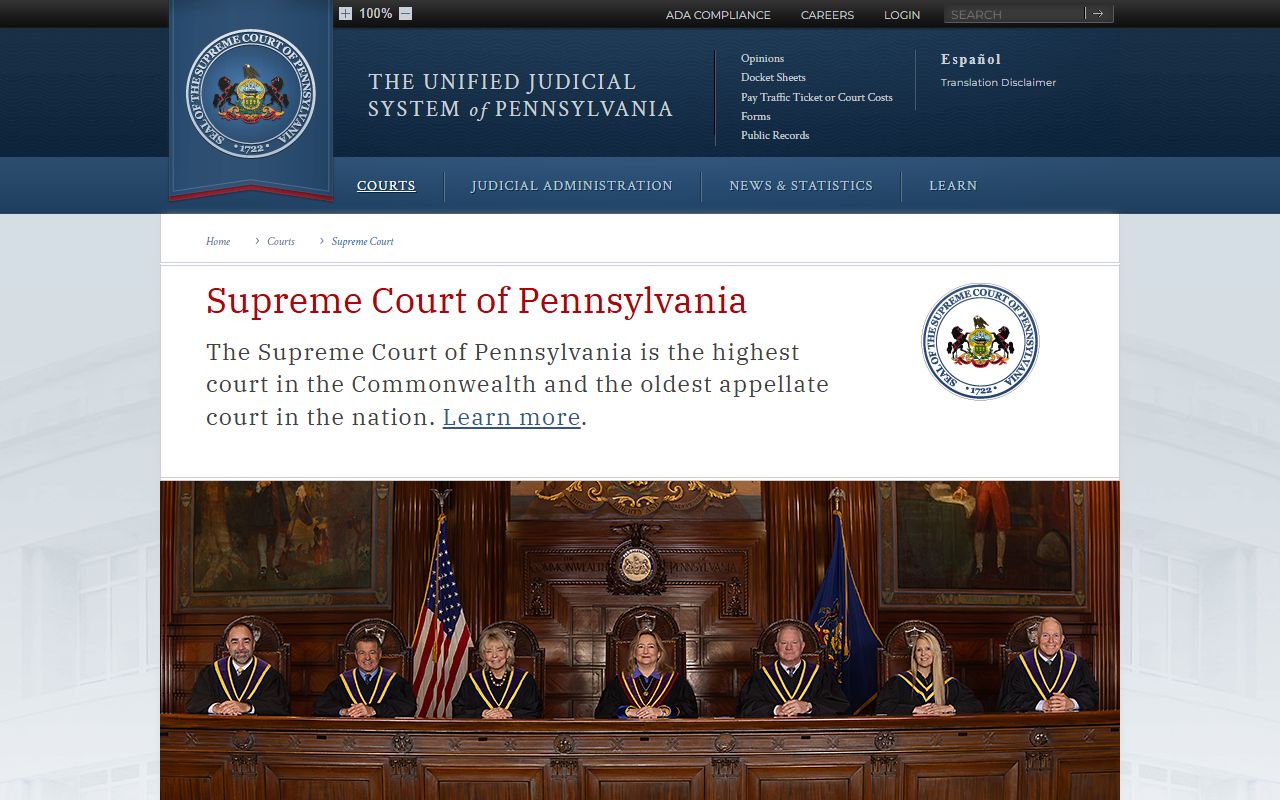
The Supreme Court's criminal decisions often involve challenges to how felony records are created, sealed, or used in later proceedings.
The Superior Court handles the largest share of felony appeals in the state. It reviews trial court decisions for legal error, reviews sentencing decisions, and can order new trials or modified sentences. Many of its published opinions deal directly with how 18 Pa.C.S. § 9122 (limited access and sealing) applies to prior felony convictions.
The PA Superior Court page, pictured here, outlines the court's criminal jurisdiction and provides access to published opinions that often address felony conviction records and appeals.
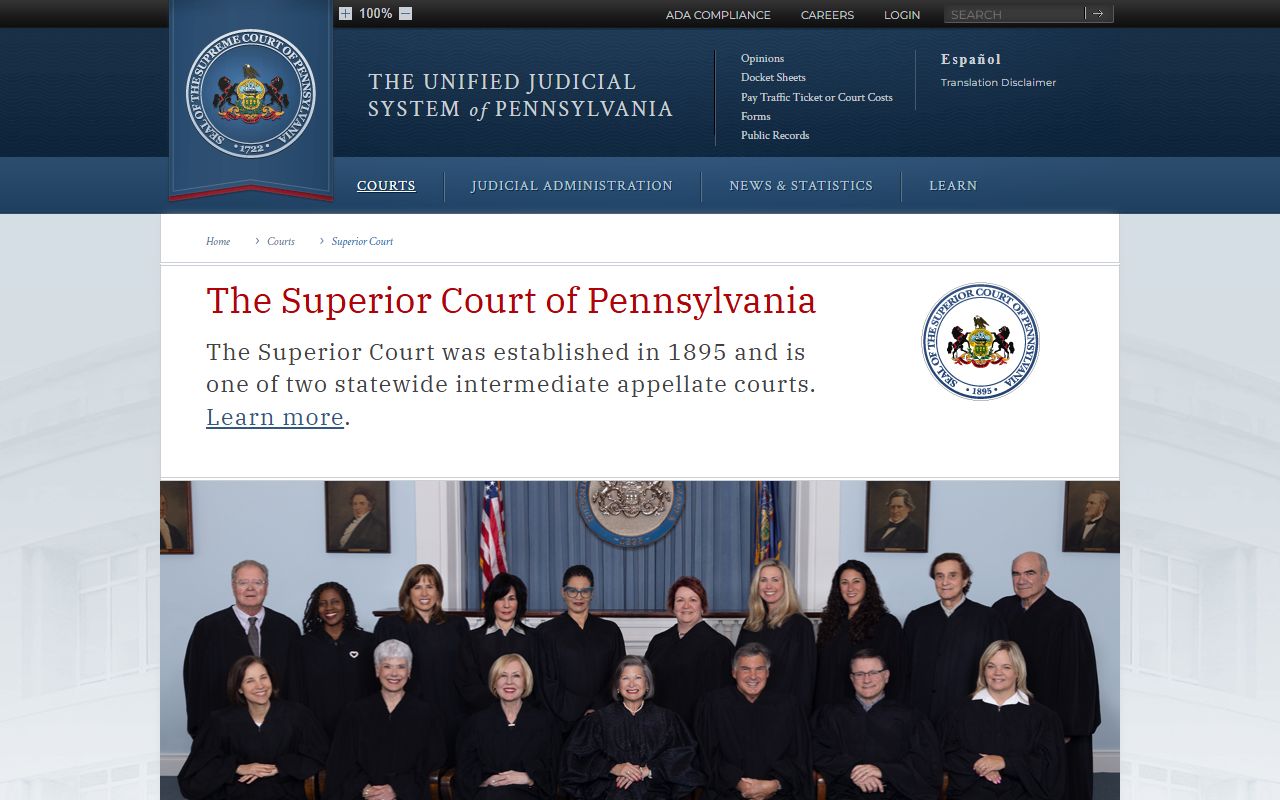
Published Superior Court opinions are searchable on the UJS Portal and provide important context for understanding how felony charges are resolved on appeal.
The PA Court Forms page is also useful if you need to file a motion related to criminal records, request a certified copy, or respond to a court action in a felony case.
Pennsylvania Parole Board Supervision Records
After release from a state prison, many people convicted of felonies in Pennsylvania are placed under the supervision of the Pennsylvania Board of Probation and Parole (PBPP). The parole board decides whether to grant parole, what conditions apply, and whether to revoke parole if a person violates the terms. The board works closely with the DOC and the courts. Parole supervision records are maintained by the PBPP and are not the same as the criminal court records held by the Clerk of Courts.
The PBPP homepage, shown here, explains the board's role in supervising people released from Pennsylvania state prisons on parole following a felony sentence.
The PBPP website includes information on how to contact a parole agent and how to look up the status of a person under active supervision.
The PA Parole Board also publishes reports on recidivism, supervision statistics, and program outcomes. These reports provide context for how felony records in Pennsylvania connect to post-release outcomes across the state.
Right-to-Know Law and Pennsylvania Felony Records
Pennsylvania's Right-to-Know Law, codified at 65 P.S. § 67.101, gives the public the right to request records from government agencies. For felony records, this law is most relevant when you are seeking records from executive branch agencies, such as the State Police or the Department of Corrections. Court records are governed by a separate set of access rules under the court system's own public access policy, not by the Right-to-Know Law directly.
The Office of Open Records (OOR) oversees compliance with the Right-to-Know Law. If an agency denies your records request, you can appeal to the OOR. The office moved to a new address effective November 24, 2025: 555 Walnut Street, Suite 605, Harrisburg, PA 17101. You can also submit and track appeals online through the OOR's portal at openrecords.pa.gov.
The Office of Open Records homepage, shown here, provides the appeal process and resources for anyone who has been denied access to Pennsylvania government records, including felony-related documents.
The OOR's decisions are publicly posted and searchable, so you can review how similar requests have been resolved in the past.
Note: Right-to-Know requests to the State Police for criminal history records are handled separately from PATCH, and the agency may apply exemptions under 18 Pa.C.S. § 9101 to certain categories of criminal history data.
Clean Slate and Expungement of Pennsylvania Felony Records
Pennsylvania has expanded its record sealing options significantly in recent years. The Clean Slate 3.0 law took effect on February 12, 2024. Under this law, certain low-level felony convictions are now eligible for automatic sealing after a waiting period. Covered offenses include theft, trespass, forgery, fraud, and drug crimes where the sentence was shorter. The waiting period for those felonies is 10 years from the date of conviction or release from supervision, whichever is later.
For misdemeanor convictions, the sealing period is 7 years. Summary convictions are sealed automatically after 5 years, a change that took effect in June 2024. Sealing under 18 Pa.C.S. § 9122 removes the record from public view but does not destroy it. Law enforcement agencies and courts can still access sealed records. Full expungement under 18 Pa.C.S. § 9121 requires a court order and is only available in limited circumstances, such as when a charge was dismissed or the person was acquitted.
For people seeking a pardon, the Board of Pardons reviews applications and makes recommendations to the Governor. The pardon process typically takes 2 to 3 years from application to final decision. The Board of Pardons is located at 333 Market Street, 15th Floor, Harrisburg, PA 17126-0333. You can reach the office by phone at (717) 787-2596.
The Board of Pardons page, pictured here, outlines the pardon application process for Pennsylvania residents with felony convictions seeking relief from the consequences of a criminal record.
A pardon does not erase the felony record but does restore certain civil rights and may allow expungement in some cases after the pardon is granted.
PA Commission on Crime and Delinquency
The Pennsylvania Commission on Crime and Delinquency (PCCD) is the state agency responsible for planning, funding, and coordinating criminal justice programs across Pennsylvania. It does not maintain felony records directly, but it funds many of the programs that interact with people who have felony convictions, including reentry services, victim assistance, and community supervision alternatives. In recent years, the PCCD has distributed $42.5 million for community safety initiatives and $160 million for school safety, mental health, and gun violence reduction programs across the state.
The PCCD homepage, shown here, provides an overview of statewide crime and justice programs funded through the commission, many of which affect how felony records and convictions are handled after sentencing.
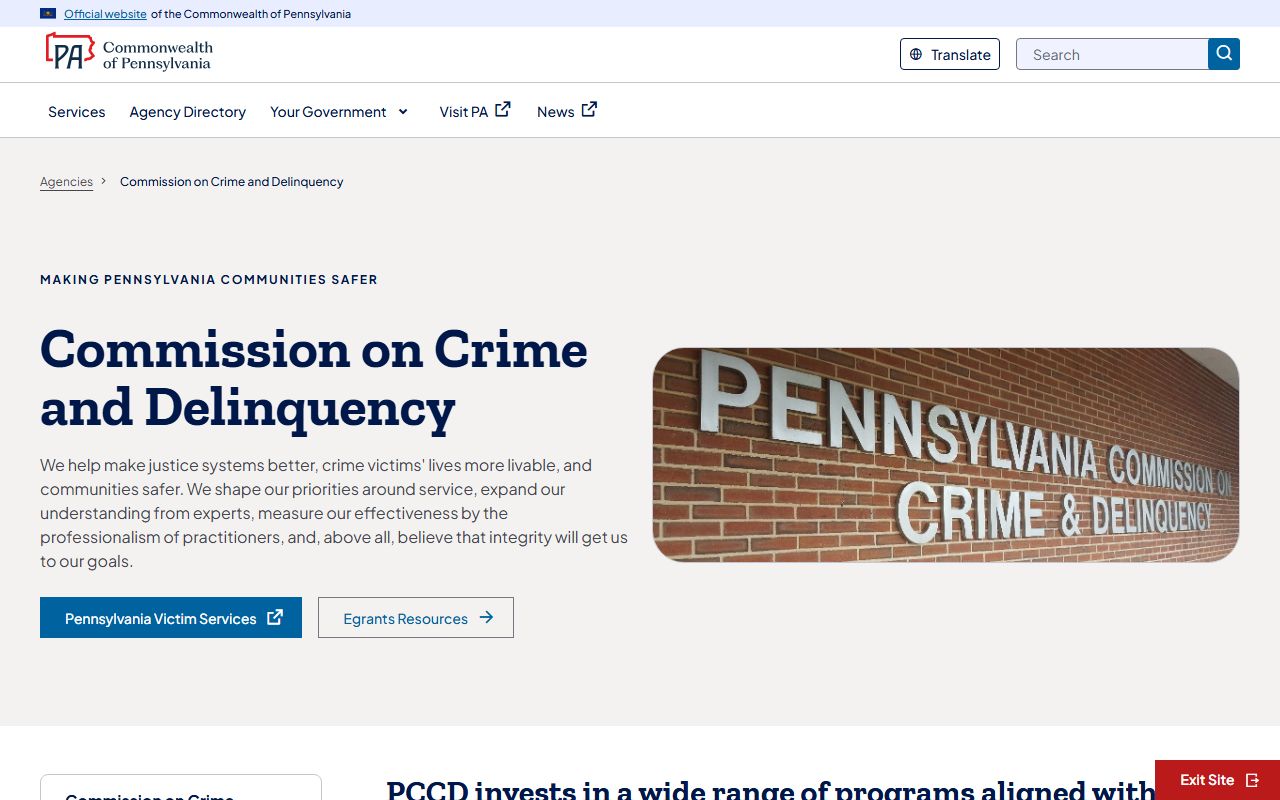
The PCCD also publishes statewide crime data reports that include felony offense trends across counties and demographic categories.
The PA Commission on Crime works alongside the courts, law enforcement, and DOC to shape how felony cases are prosecuted and managed from arrest through reentry. Its grant programs reach every county in the state and affect how local agencies fund public safety operations and record-keeping systems.
Browse Pennsylvania Felony Records by County
Each of Pennsylvania's 67 counties maintains its own Court of Common Pleas with a Clerk of Courts office that holds felony case files. County-level records include charging documents, plea agreements, trial transcripts, and sentencing orders. The ten most populous counties are listed below. Select a county to find felony record resources for that jurisdiction.
View All Pennsylvania Counties
Felony Records in Pennsylvania Cities
Major Pennsylvania cities generate a high volume of felony cases each year. City-specific pages bring together the local court divisions, police department resources, and county clerk offices that serve each urban area. Select a city below to find felony record search resources for that location.